Planets are found by blinking
Compare SPHEREx images of the sky from different dates and see what moved.
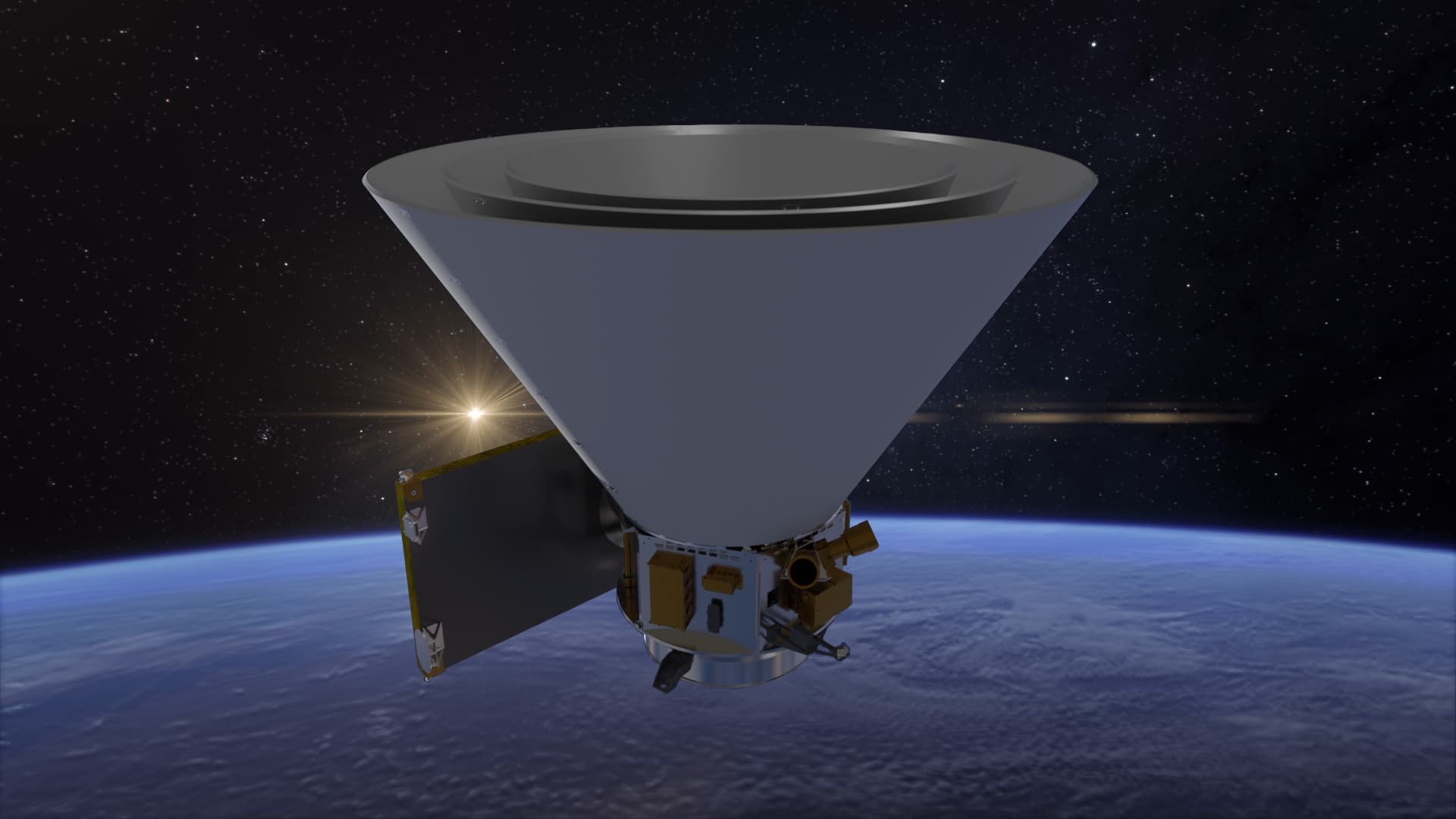
SPHEREx in orbit, artist's concept. NASA/JPL-Caltech, PIA26531
In 1930, Pluto was found by blinking.
Clyde Tombaugh compared two photographic plates of the same patch of sky, switching between them in the eyepiece of a blink comparator. Thousands of stars stayed put. One point moved.
Days between plates
Stars used to register
Mean error
px
Plate A
23 January 1930
The real Lowell Observatory plates. We registered the second onto the first using 110 stars, mean error 0.9 px. The arrows were drawn by Tombaugh himself.
Clyde Tombaugh, Lowell Observatory, 1930. Public domain.
Today the plates are taken from orbit.
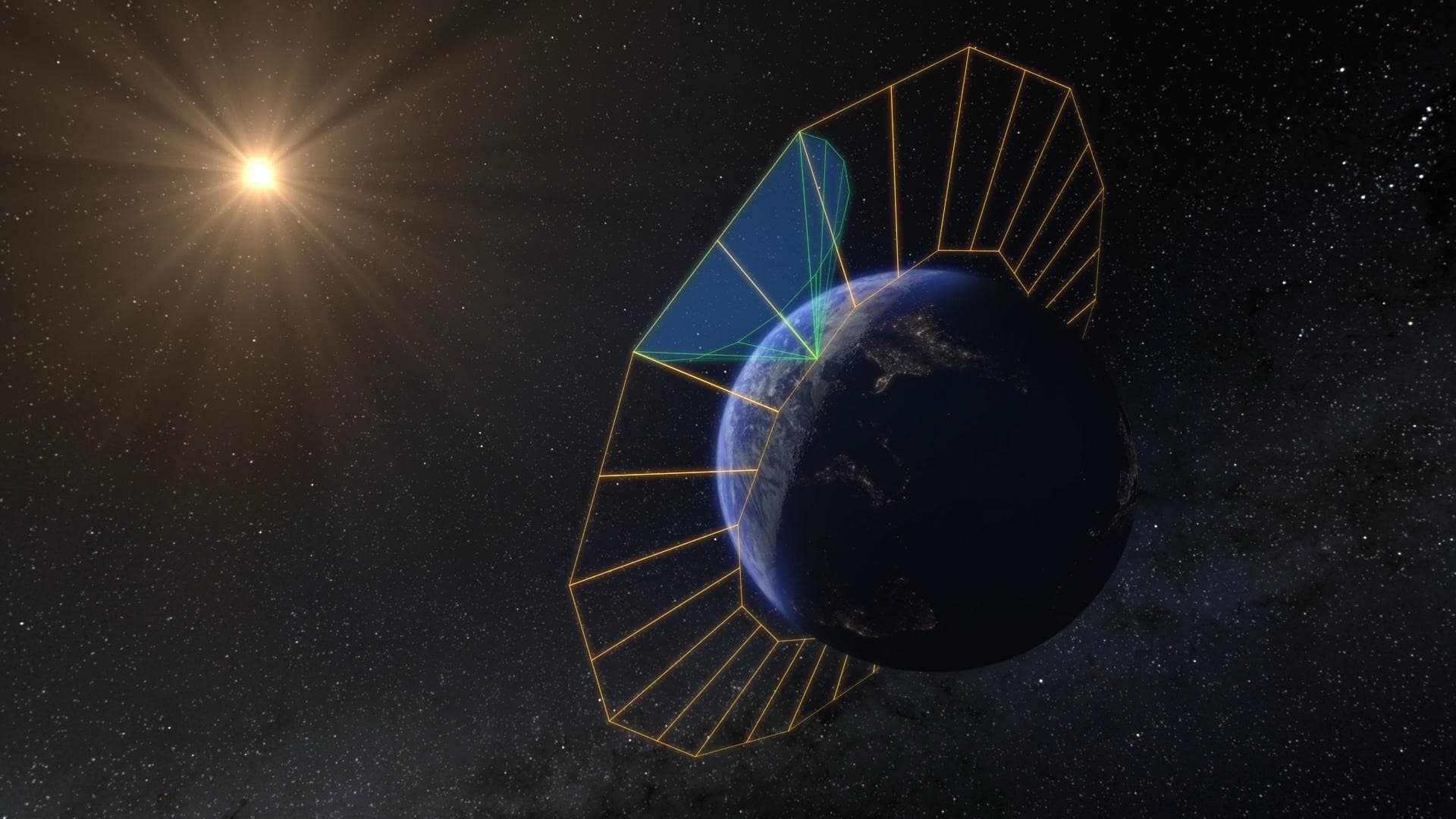
SPHEREx circles Earth about 650 km up, on a polar orbit that stays over the line between day and night. One lap takes about 98 minutes.
- Altitude
- ≈km
- One orbit
- ≈min
- Orbits a day
- ≈
Three cones keep it cold.
Three nested photon shields, 3.2 m across, keep the heat of the Sun and Earth off the telescope. Mirrored V-grooves beneath them send the rest out into space. No coolant, no power.
- Diameter
- m
- Height
- m
- Detectors at
- šC
A 20 cm eye with a wide view.
Inside the cones sits a three-mirror telescope. Each exposure covers 11.3° by 3.5° of sky, and six detectors behind it split the light into 102 infrared colours.
- Aperture
- cm
- Field of view
- Detectors
Light split 102 ways.
Three mirrors fold the light down the telescope. A dichroic beam splitter sends the shorter waves to one focal plane and the longer to the other. Over each of the six detectors sits a linear variable filter that passes a different colour along its length, so as the sky drifts across, every point is seen in 102 colours.
- Wavelengths
- µm
- Colours
- Focal planes
The whole sky every six months.
Each orbit, the telescope images a 360° strip of sky. As Earth goes around the Sun, the strip slowly moves on, and in six months the map is complete. The prime mission makes four.
- Strip per orbit
- Whole sky
- months
- All-sky maps
3D model built by us from NASA/JPL published dimensions, not a photograph. Earth: NASA Blue Marble and Black Marble. Sky: SPHEREx all-sky map 2025, NASA/JPL-Caltech.
SPHEREx sees the sky in colours.
NASA's infrared telescope maps the whole sky from 0.75 to 5.0 µm: six detectors with 17 channels each.
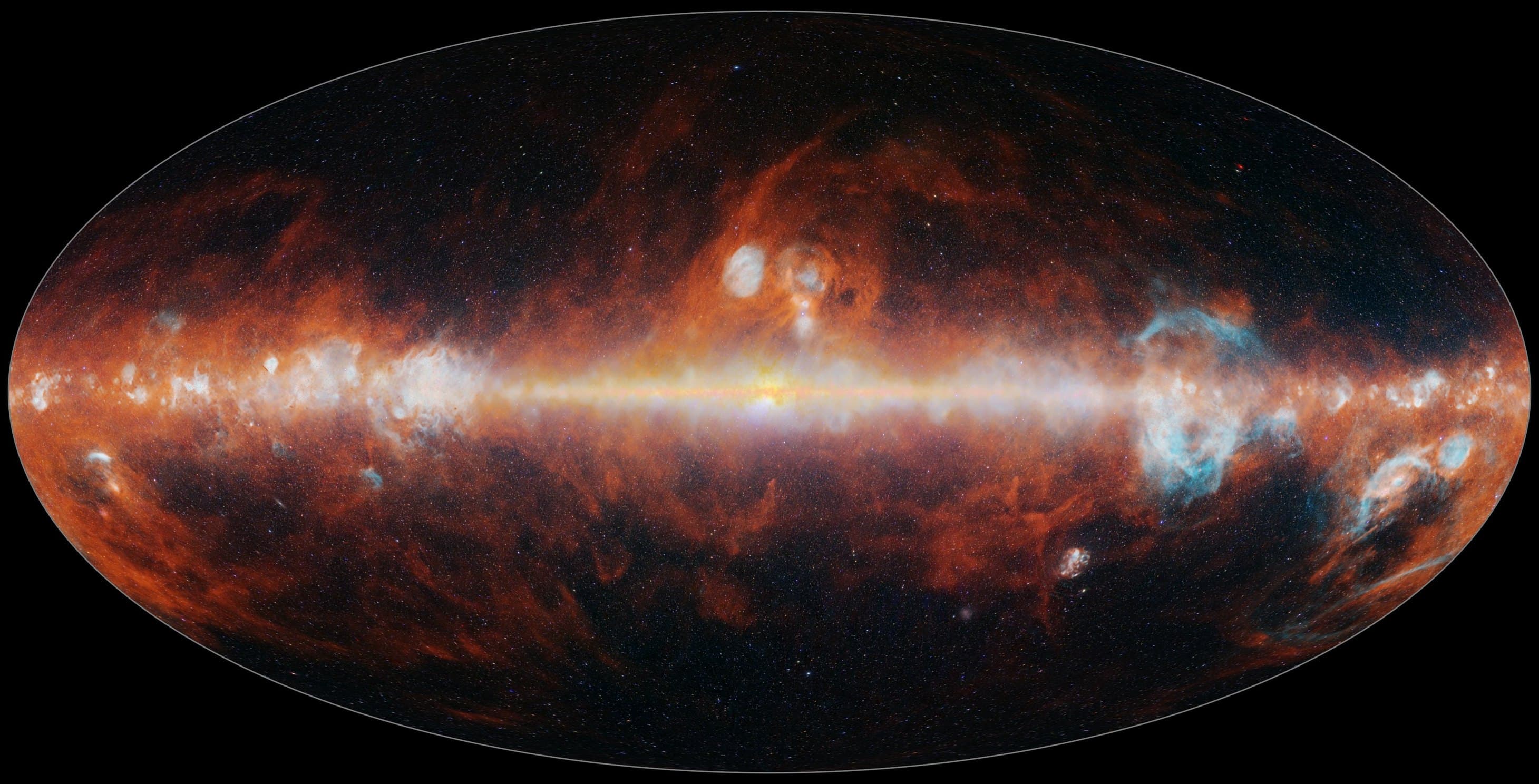
Six detectors, one channel at a time.
Pick a channel on the strip or a detector frame: the frame that holds that wavelength lights up.
Date and wavelength are two different axes. We never mix them up.
SPHEREx first images, 27 March 2025: one frame from each of the six detectors. Colours are assigned: infrared light is invisible. NASA/JPL-Caltech, PIA26280
Align first. Then show.
Images from different dates are taken with different rotation and offset. Without alignment by sky coordinates (WCS), every star would blink with false motion. We never show an unaligned frame.
- 01Read each frame’s sky coordinates (WCS)
- 02Reproject frame B onto frame A’s grid
- 03Check the overlap and the residual
- 04Blink: everything stays put except what moved
Illustration of the process. The numbers were measured on live frames.
Before alignment
px
After
px
Frame overlap
%
Frames A and B
Try it right here.
A real request to the archive: object name, list of observations, cutouts, alignment and blink.
01Object coordinates
02Observations in the archive
03Cutouts and alignment
04Blink
Saved example: real SPHEREx frames, M 31
1 / 2


Frames are normalised independently: brightness between them is not directly comparable.
One site. Two modes.
Simple mode walks you through. Advanced opens everything the data holds.
- Search by name, coordinates or a click on the map
- Two images of the same patch, aligned in advance
- Blink from 1 to 5 Hz and a date timeline
- An “Explain this screen” button
- A link to the current view, ready to share
SPHEREx all-sky map 2025, detail. NASA/JPL-Caltech
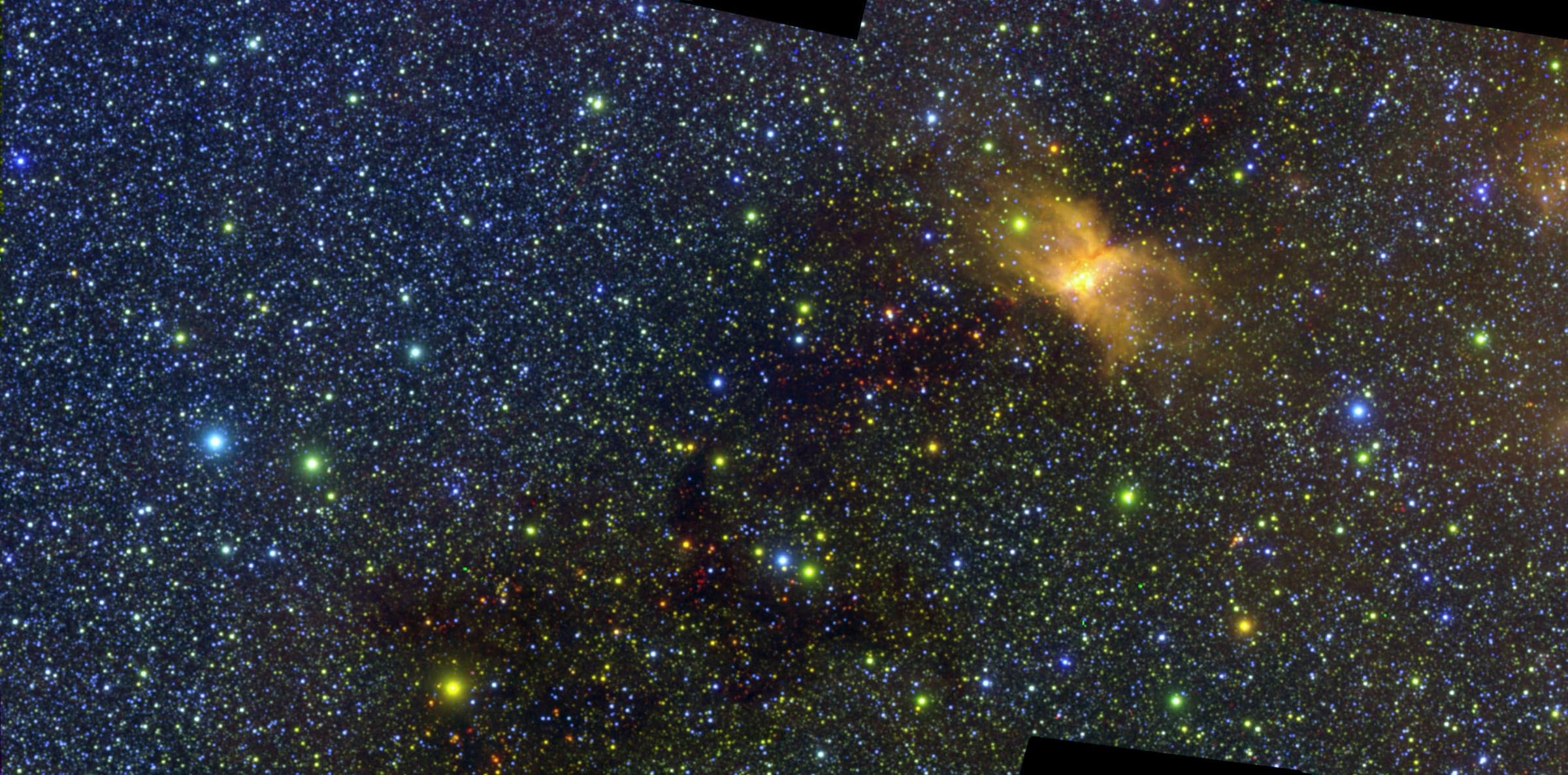
Three wavelengths, one picture.
This is what an RGB composite looks like in Advanced mode: each colour stands for its own band of the infrared spectrum.
- Red
- 4.54-4.65 µm
- Green
- 2.83-3.20 µm
- Blue
- 0.74-0.88 µm
Vela Molecular Ridge, SPHEREx. The yellow patch on the right is the RCW 36 nebula. NASA/JPL-Caltech, PIA26354
We describe. We do not announce discoveries.
We will say
- The source moved between observations
- The change is visible in only one frame
- Low signal-to-noise ratio
We will never say
- This is an asteroid
- A new planet was discovered
- AI found an object
The sky is already photographed. Now look.
From two glass plates in 1930 to the whole sky in 102 colours.
- Pluto found by blinking
- Colours for every point
- For the whole sky
- months
- All-sky maps planned